Showing posts with label Shwedagon Paya. Show all posts

Saturday, February 6, 2016

Final Day in Bagan

Another 5:30 a.m. morning took us to a pagoda with stairs that led to a top level where we could witness the rising sun and the balloons floating by the shrines.  There were lots of people gathered there for the same purpose and at times small conflicts arose while each person was staking out their territory.  The balloons floated by in the distance with shrines poking their heads through the haze.  It was well worth the shortened night of sleep.


We returned to the hotel for a quick breakfast before walking to a nearby shrine where Liza and Ira with the help of a local set up a shoot for us.  Candles were placed at the base of the sitting Buddha.  They had arranged two novice monks to serve as our models this morning.  Light filtered in the door giving us just enough illumination to take some very nice photos.

We gathered for our last critique right after we dined on pizza from the hotel's wood fired pizza oven. It’s hard to believe our trip is almost over.  A scheduled sunset shoot was scrapped in favor of some free time to see the town.  Some headed to the river to see how the locals work and play.

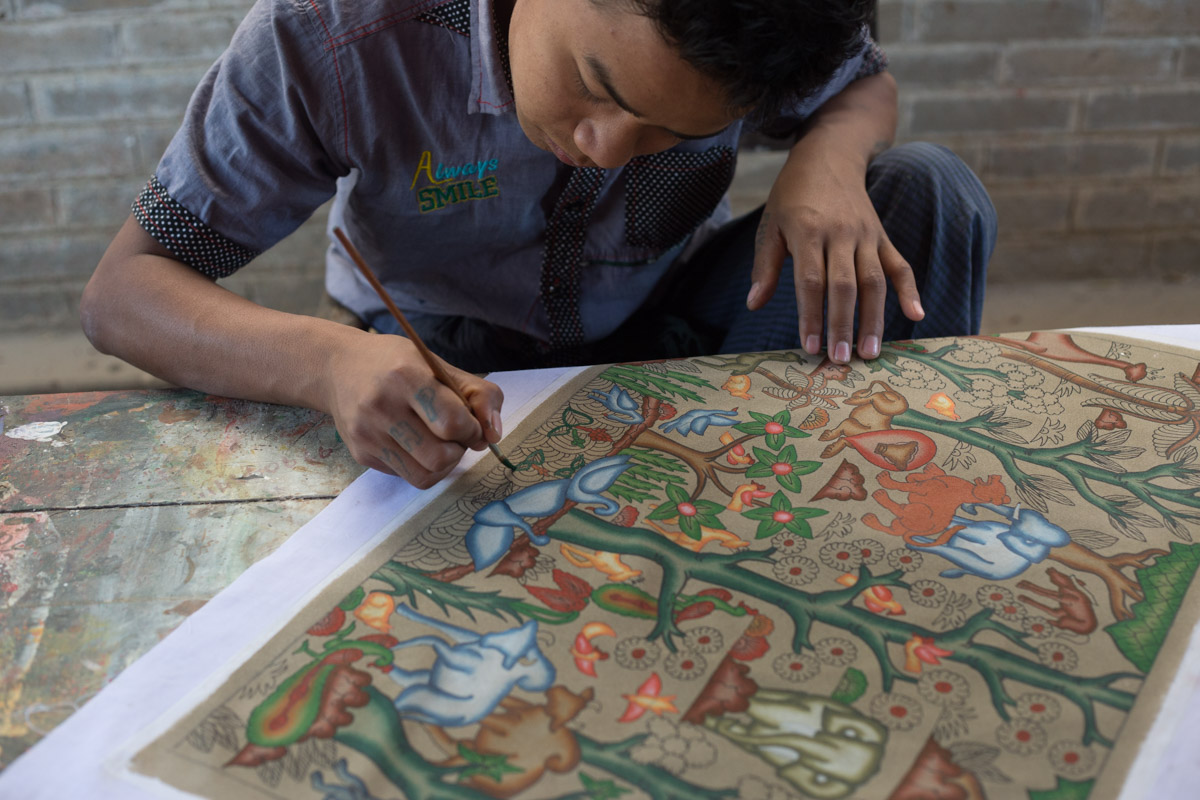
Our small group rented electric bikes to go with a local to see his village and the craftsmen that make the wares sold around the shrines.  His family’s specialty is sand painting.  Several craftsmen were stationed at tables with paintings in various stages of completion.  The designs come from both temple designs and books they copy from. 


Next we walked down the street to a bamboo facility.  Long bamboo sticks that are harvested in the surrounding hills were stacked in racks waiting to be cut into long strips.  These strips can then be woven into mats, wall coverings and lacquer boxes.  We hopped on our bikes to go a short distance to watch lacquer items being created.  The best lacquer takes six months to be completed, with 14 layers of lacquer applied in one week intervals.  Other items such as ground bones and mineral dust is mixed into lacquer at certain stages to make it strong.  In addition to using bamboo, some of the items are made with wood or even woven horsehair (a quite difficult material to weave).  Cheaper versions are also available but the quality differences are easily spotted.


We biked down to the river to see the fishermen and the boats that lined the shore.  Boats leave from here to take passengers on a several hour journey to Mandalay.  The river is used to bath in, as a washing facility and also fishing grounds.  We returned to our hotel tired and ready to eat, pack and hit the sack.  Unfortunately, the festival across the hotel was in its final evening which meant loud music that stretched well past midnight.  The front desk provided ear plugs if the noise was too much, but I somehow slept through most of it needing to catch up from our 5:30 a.m. morning calls.


Next: Our final hours in Myanmar

Friday, January 29, 2016

You're Not in Kansas Anymore

One of the larger markets in Rangon is right around the corner from our hotel and seemed like a good way to get introduced to the cultural.  We crossed over a bridge that strateled the railroad tracks to get to the market.  On the bridge vendors had set up tables to sell various things - fruits, vegetables, cooked food, cigarettes, etc.  None of these shops are permanent which is a scene we would see recreated throughout the city.  The market was very large and we didn't make it through even half of it. There were lots of shops set to sell you jewelry, from trinkets to expensive raw stones.  Unlike other similar markets I've visited, the vendors lacked any aggression to sell their merchandise.  That's not to say they didn't try to entice you if you stopped to take a peak but there was no attempt to grab you from the aisles to try to sell you their goods.

We had been told the Shwedegon Pagoda, probably the best known religious site in Myanmar, was an easy walk from our hotel.  While not too far in distance, the uneven, potholed streets made walking difficult and the trafficked streets hard to cross.  We were quite grateful when the golden stupa came into view.  We entered the complex at the base of the pagoda which meant either lots of stairs or taking the series of escalators to the top.  There were several famllies with older women that were afraid to step onto the 'magic steps'.  Guards tried to help them on and for some this worked.  Others opted for the stairs.  I guess it never occurred to me how frightening these could be.

The temple complex covers over 14 acres and is home for many small open air buildings that contain anywhere from 1 to dozens of gold leaf Buddhas. I think the most surprising thing to me was the use of multi-colored moving lights behind the Buddha heads that gave it a Vegas feel.  It seemed so out of place for such an ancient site.  This particular day a relic from Budda was on display which meant lots of people in a snaking line across the marble tiled plaza, most with umbrellas of some kind.  It really was quite a sight.


Instead of signs of the zodiac, the Burmese assign animals to days of the week on which a person is born.  These days are represented around the circle with Buddhas where people place flowers and pour water on the statutes although I can't offer an explanation why.  Monks roamed through the crowds stopping at shrines to pray.  It was all quite magical.


We decided to escape the noonday sun and return to our hotel, this time by cab.  The traffic is horrendous mainly because public transit is insufficient.  This means cabs are everywhere filling in the gaps. A ride that should take 10 minutes stretches to  30 to 40 during normal traffic.

We ate a late lunch in the hotel, rested a little then started our walk to the only gallery in Myanmar dedicated to photography.  Our instructors, Ira and Ari, were giving a lecture this evening on photography.  At night, street vendors pop up everywhere selling street food.  They have make-shift kitchens and even small dining rooms right on the street.  This made the walk very interesting if slowing it somewhat.

The gallery was upstairs in a block of doorways and alleyways.  You had to have a little faith that you were in the right place as you climbed the darkened stairway.  The structure appeared to be quite old and the less than stable wooden floor limited the number of people that could attend.  Afterwards, we opted for the quick (the traffic had died down) and cheap (all cab rides appear to be under $3) ride home.  The food vendors had disappeared, the dinner hour apparently being over.

This was a great first day in this beautiful country.

Next: A reclining Buddha